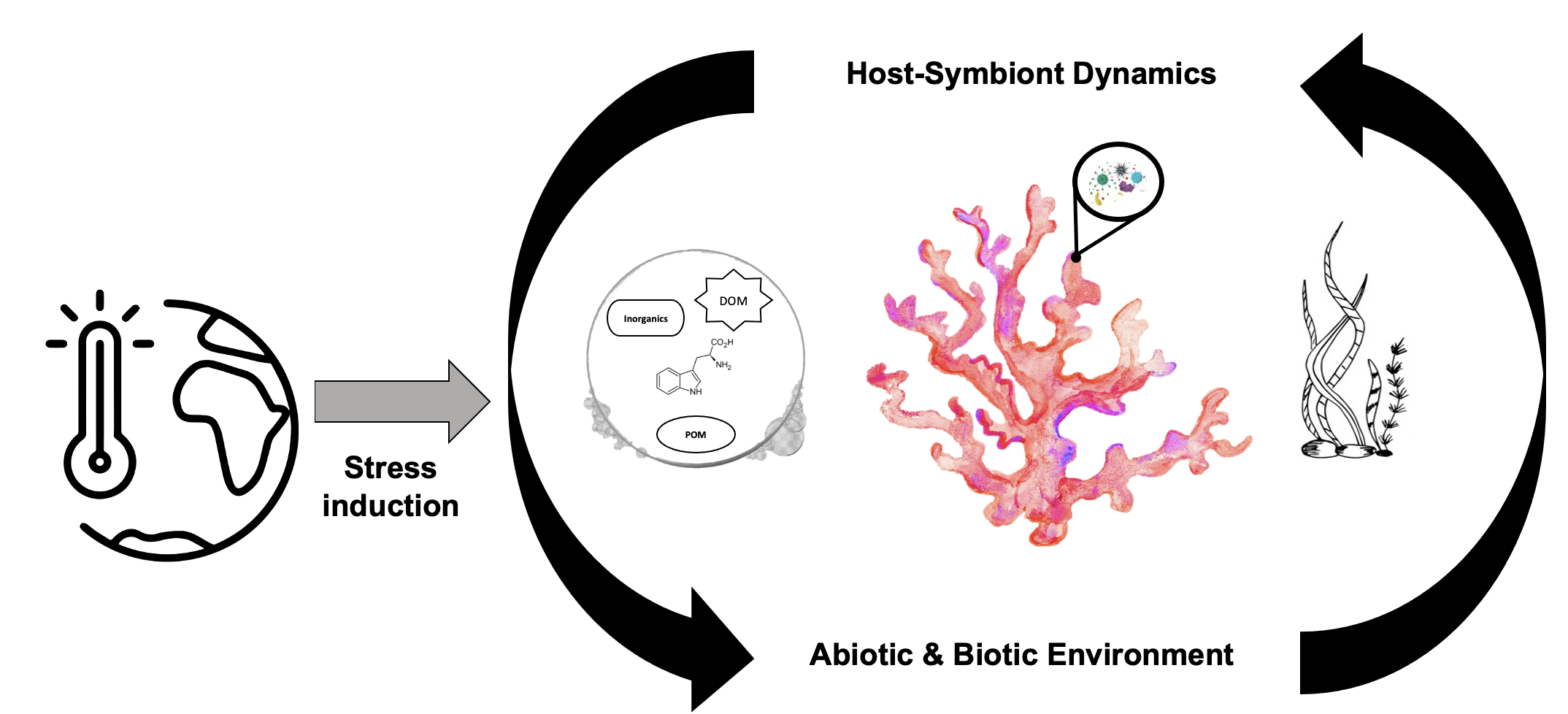
Building on my unique interdisciplinary background, my research seeks to advance our understanding of complex host-symbiont dynamics, their connections to the biotic and abiotic environment, and the influence of stress induction on these vital ecological links. I utilize a suite of microbial ecology, molecular biology, and biogeochemical tools built around a core of fieldwork and ecosystem monitoring to address these questions in aquatic habitats using invertebrate holobiont models.
Current Research
Cycling of dissolved organic matter (DOM) by the sponge holobiont
NSF-funded Postdoctoral Research in the Fiore Lab
Project PIs: Cara Fiore (Appalachian State), Amy Apprill (WHOI), Cole Easson (MTSU)
Project Collaborators: Chris Freeman (College of Charleston), Craig Nelson (UH-Mānoa)
Sponges are known for their efficient uptake of organic matter, both particulate (POM) and dissolved (DOM), from the water column. More recently, there is evidence that sponges, and their associated symbionts, also produce DOM rich in nucleosides and other unidentified metabolites that is transferred to the surrounding reef via their exhalent seawater. However, little is known about the composition of this DOM across sponge species and its effect on other reef biota. Current projects include:
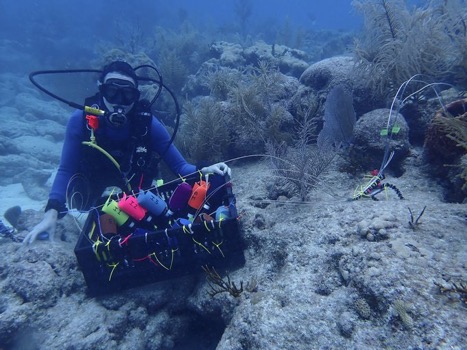
Characterization of the sponge exometabolome. This project seeks to compare the nutrient composition of exhalent water for 6 emergent Caribbean sponge species using a combination of targeted and untargeted metabolomics, biogeochemical analyses, and flow cytometry. We will also employ amplicon and metagenomic sequencing to characterize the sponge microbiomes to better understand their role in the processing and transformation of the nutrients.
Does exposure to the sponge exometabolome alter the composition of reef picoplankton communities and subsequently impact their biogeochemical cycling? To address these questions, we exposed reef picoplankton communities to either filtered sea water (control) or a sponge exometabolome mixture in closed, dark incubations for 48 hrs. We used 16S rRNA gene sequencing and flow cytometry to identify picoplankton compositional changes and a suite of analyses to identify nutrient components contributed by the sponge to reef water and to monitor changes in the incubation bottles, including: metabolomics, fDOM, dissolved combined neutral sugars, total organic carbon, total nitrogen, and inorganic nutrients.
Can the coral holobiont assimilate sponge-derived dissolved matter (DM)? We used a stable isotope ‘pulse-chase’ experiment to investigate the incorporation of 13C- and 15N-enriched sponge-derived DM into the tissues of three Caribbean corals including two scleractinians (Acropora cervicornis and Orbicella faveolata) and an octocoral (Eunicea flexuosa). This work was recently published in Communications Biology (Read the article here).



Past Research
Relative roles of the environment and host genetics in shaping coral symbiont communities and the impacts of stress on microbiome composition and function
Advisor: Dr. Michael Hellberg (Hellberg Lab)
The role of the coral microbiome in host acclimation to a natural extreme environment. Most tropical corals thrive in water temperatures of 27C and pH 8. Conditions outside of these can lead to stress, disease and mortality. However, in the Gulf of Mexico, the scleractinian Porites panamensis can be found living in close proximity to a set of shallow hydrothermal vents where water conditions are both extremely hot and acidic (> 80C, pH < 6). Despite these extreme conditions, P. panamensis microbiomes from the vent habitats did not display typical signs of stress, but instead showed signs of acclimation to the inhospitable waters. [Read Article]
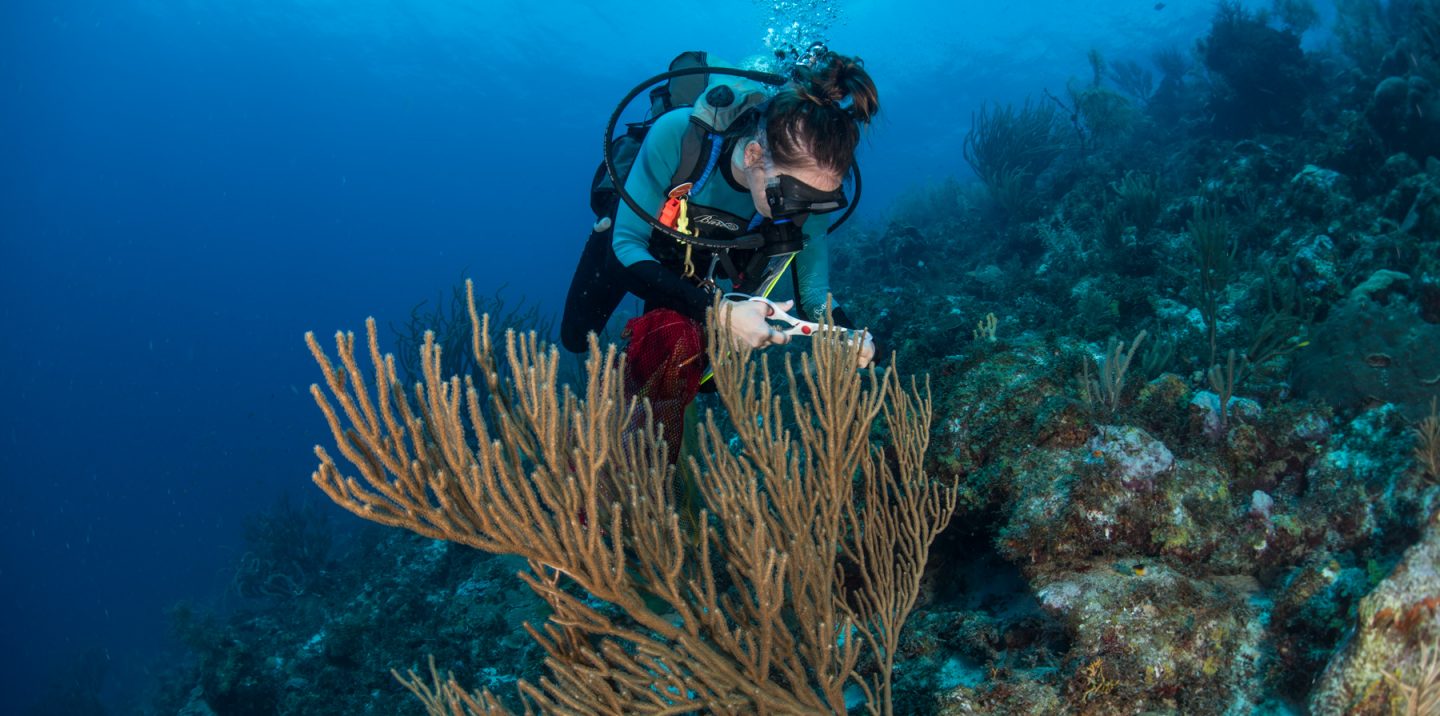
Examining shifts in gorgonian-associated microbial communities in response to long-term anthropogenic stress in shallow coastal reefs of the Caribbean. Characterizing the microbial composition of coral hosts living on reefs exposed to long-term anthropogenic stressors such as nutrient loading, high sedimentation rates, and thermal stress. Illumina MiSeq sequence data from tissue, water and sediment samples coupled with available long-term water quality monitoring data, will provide a picture of how these stressors are driving the taxon composition of the gorgonian microbial assemblages.
Reducing host DNA contamination in 16S rRNA gene surveys of anthozoan microbiomes using PNA clamps. We developed an inexpensive peptide nucleic acid (PNA) clamp that binds to a target sequence of host DNA during PCR and blocks amplification and tested its efficacy on three coral species including two octocorals (Eunicea flexuosa and Gorgonia ventalina) and one scleractinian (Porites panamensis). Adding the PNA clamp during PCR increased the percentage of microbial reads in E. flexuosa samples more than 11-fold and in G. ventalina samples by 8.6-fold without impacting beta diversity of the microbiome. Microbial reads doubled in the distantly-related P. panamensis with the addition of the PNA clamp. [Read Article]

Population Genetics of an Invasive Species of Barncle, Megablanus coccopoma
Advisor: Dr. Daniel Gleason (Gleason Lab) and Dr. J. Scott Harrison (Harrison Lab)
I developed molecular markers for a population genetics analysis of the invasive barnacle M. coccopoma [Read Article]. Then I employed the markers to examine the role of artificial structures in the range expansion of M. coccopoma, in the southeastern United States [Read Article – See Project 4].

Long-Term Benthic Biodiversity Monitoring of Gray’s Reef National Marine Sanctuary
Advisors: Dr. Daniel Gleason (Gleason Lab) & NOAA (GRNMS)

Yearly monitoring of benthic diversity at Gray’s Reef National Marine Sanctuary (GRNMS). This work is done in collaboration with NOAA Gray’s Reef staff and is ongoing. Work involves identification (to the genus or species level)of sessile benthic invertebrates across the Sanctuary. This work is part of an ongoing effort to gain insight into temporal fluctuations and recruitment of sessile inverts at Gray’s Reef.
Using prey fish species as bioindicators of anthropogenic stress and predictors of predator density and diversity
Advisor: Dr. Amanda Hollebone
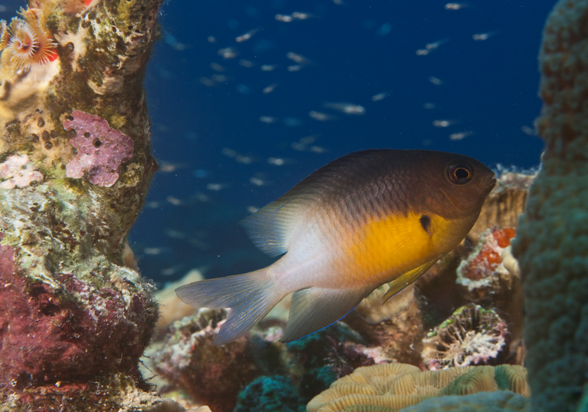
My undergraduate research was conducted over a 15-week intensive research experience through CIEE Bonaire. I examined fish species as early detection indicators of changes in reef habitats as a result of anthropogenic activities in the coastal waters of Bonaire, N.A. The bicolor damsel fish (Stegastes partitus) was identified as a potential bioindicator for Caribbean reefs because its population densities correlated positively with higher anthropogenic impacts and negatively with density of predator fishes. This work was published in a Caribbean-based undergraduate research journal Physis. Check out the journal here or read my article here.